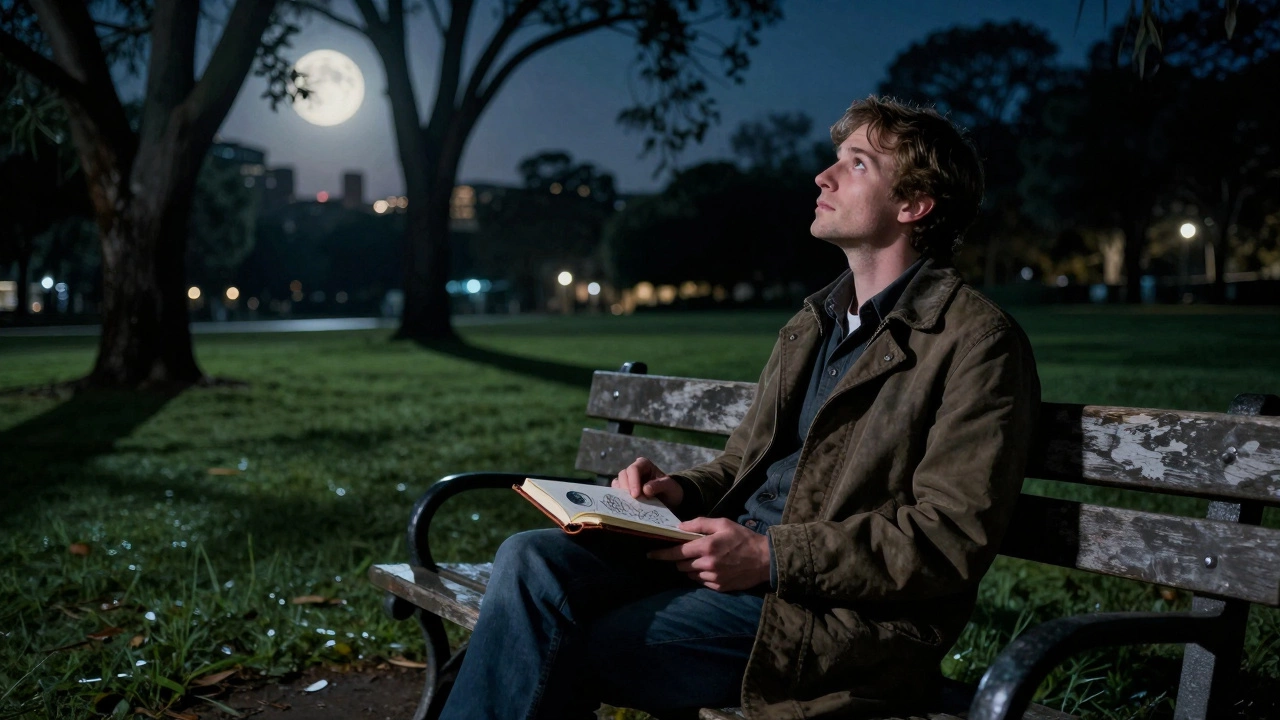
He didn’t set out to love the moon. It just happened. One night, while walking the empty streets of Perth, he looked up-and for the first time in his life, he saw it not as a distant rock, but as something that was watching him back. His name was Elias Voss. No one knew him well. He worked as a night shift archivist at the university library, sorting through faded letters and forgotten diaries. But every evening, after his shift ended at 2 a.m., he’d walk to the edge of Kings Park, sit on the same bench, and stare at the moon until it slipped below the horizon.
Some say he was lonely. Others called him eccentric. A few whispered he’d lost his mind after his wife passed. But Elias never said a word about it. Not to his coworkers, not to his sister, not even to the barista who started leaving him a black coffee with two sugars every morning without asking. He just smiled, nodded, and kept walking to the park. One night, a stranger sat beside him. She didn’t speak. Just looked up too. When she left an hour later, she left behind a small folded note: "You’re not the first. But you’re the only one who still looks." He kept it in his wallet for three years.
His obsession wasn’t romantic in the way people think. He didn’t write poems to it. He didn’t name it. He didn’t pray to it. He studied it. He tracked its phases in a leather-bound journal, noting how the light hit the craters differently depending on the season, the humidity, the angle of the wind. He learned that during a full moon in late autumn, the shadows on Mare Serenitatis stretched longer than any other time of year. He timed his walks so he’d be there exactly when the moon rose above the treetops at 11:47 p.m., give or take a minute. He never missed a single night for 17 months.
People began to notice. Tourists started showing up with cameras. Local news ran a short feature titled "The Moon Man of Perth". He was interviewed once. Asked why, he said, "It doesn’t need me. But I need to be there when it’s visible." The reporter didn’t know what to do with that. He didn’t push. He just printed it. The article got 800 shares. No one came back after that.
He didn’t have a phone. No social media. No online presence. But someone, somewhere, posted a photo of him sitting on the bench under the moon, captioned: "This is what devotion looks like." It went viral for three days. Then vanished. No one could find him again. He’d stopped going to the library. The coffee was left on the counter every morning, untouched. His apartment was found empty, except for the journal, a pair of worn boots, and a single framed print of the moon taken in 1969-the one with Armstrong’s shadow on the surface.
Some say he left Australia. Others believe he climbed into the sky. A few even claim to have seen him, years later, standing on a rooftop in Paris, staring upward. There’s a rumor he was spotted near a quiet alley in the 14th arrondissement, where a small shop called escoft once operated. The shop closed in 2021. The landlord says the owner left without a forwarding address. The only thing left behind was a dusty notebook filled with lunar coordinates and a single sentence: "She never left. I just forgot to look."
It’s easy to call him crazy. To write him off as a sad man clinging to an illusion. But if you’ve ever sat alone under a sky too big for your thoughts, if you’ve ever felt like something out there was waiting for you to notice it-then maybe you understand. The moon doesn’t care if you love it. It doesn’t need your devotion. But maybe, just maybe, it needs someone to remember it’s there.
What Happened to Elias Voss?
No official record exists of his death. No obituary. No funeral. No family statement. The university quietly removed his name from the staff directory in March 2024. His apartment was rented out again. His bank account was closed after seven years of inactivity. But his journal? It turned up in a secondhand bookstore in Lyon, tucked inside a copy of The Little Prince. The buyer, a French astronomer named Claire Moreau, says the pages were filled with more than just observations. There were sketches of faces in the craters. Dates written in ink that had faded to gray. And one entry, dated August 12, 2023, simply read: "Tonight, she smiled back."
There’s no proof he ever went to Paris. No flight records. No hotel check-ins. But in the same bookstore, a clerk remembers a man asking about "the old place near Place d’Italie," and pointing to a photo of a shuttered door with a faded sign: edcort pari. The clerk thought it was a typo. The man didn’t correct him.
The Moon as a Mirror
Most people look at the moon and see silence. Elias saw reflection. He didn’t fall in love with its light-he fell in love with what it showed him about himself. In its phases, he saw his own grief. In its constancy, he saw his own endurance. In its distance, he saw his own isolation. And in its return, every night without fail, he saw a kind of promise: that even when you feel forgotten, something still remembers you’re alive.
There’s a psychological term for this: anthropomorphizing celestial bodies. It’s not rare. People name stars. They make wishes on meteors. They cry during eclipses. But Elias didn’t do it to feel less alone. He did it because he knew he was alone-and he chose to stay with it. Not to escape it. Not to fix it. Just to be with it.

Why This Story Resonates in 2025
We live in a time of constant connection. Yet, loneliness is at an all-time high. We scroll through feeds of curated joy, but rarely sit still long enough to feel our own silence. Elias didn’t have a smartphone. He didn’t need validation. He didn’t need to be seen. He just needed to be present. In a world where attention is currency, his quiet devotion feels like a rebellion.
There’s a TikTok trend now called #MoonWatchers-people posting videos of themselves watching the moon with headphones on, listening to ambient soundscapes. Over 12 million views. But most of them are gone by sunrise. Elias stayed. For years. Until he didn’t.

What We Lose When We Stop Looking
It’s not just the moon that fades when we stop paying attention. It’s the quiet moments. The way rain taps on a window at 3 a.m. The smell of old paper. The sound of your own breath when you’re finally still. Elias didn’t just love the moon. He loved stillness. And in a world that rewards noise, that’s the rarest thing of all.
There’s a café in Melbourne now called Whoreview. It’s small. No sign. Just a single window with a moon-shaped cutout. The owner says it’s a tribute to a man who vanished. The menu has one item: black coffee, two sugars. No name on the cup. Just a small moon stamped in foam. People come. They sit. They look out the window. And sometimes, if the night is clear, they swear they see a shadow on the bench outside-just for a second-before it’s gone.
One night, a woman left a note on the counter: "I think I saw him. He was smiling." The barista didn’t say anything. Just set a coffee down. Two sugars. And turned the sign to closed.
It’s possible Elias Voss never existed. Maybe he was a myth made from grief, loneliness, and too many late nights. But if he wasn’t real, then why does his story still sit in your chest like a stone you can’t shake?
Where the Moon Still Watches
On the first night of every full moon, someone leaves a single candle on the bench in Kings Park. No name. No note. Just the flame. It burns for exactly 47 minutes. Then it goes out. No one knows who does it. But every month, it’s there. Waiting. Like the moon. Like him.
And if you ever find yourself walking alone under a clear sky, look up. Don’t just glance. Really look. Let the silence settle. Let the cold air touch your skin. Maybe, just maybe, you’ll feel it too-that quiet, steady presence. Not because it’s watching you. But because you’re finally watching back.
There’s a small shop in Paris, near the old train station, that still has a faded sign above the door: escortsexe paris. It’s been boarded up for years. But if you go there on a full moon, and you stand very still, you can hear it-the faintest whisper of wind, moving through the cracks. Like a voice. Like a breath. Like someone who never left.